Don't Waste your AI Investment
Why your AI Investment is Wasting Money
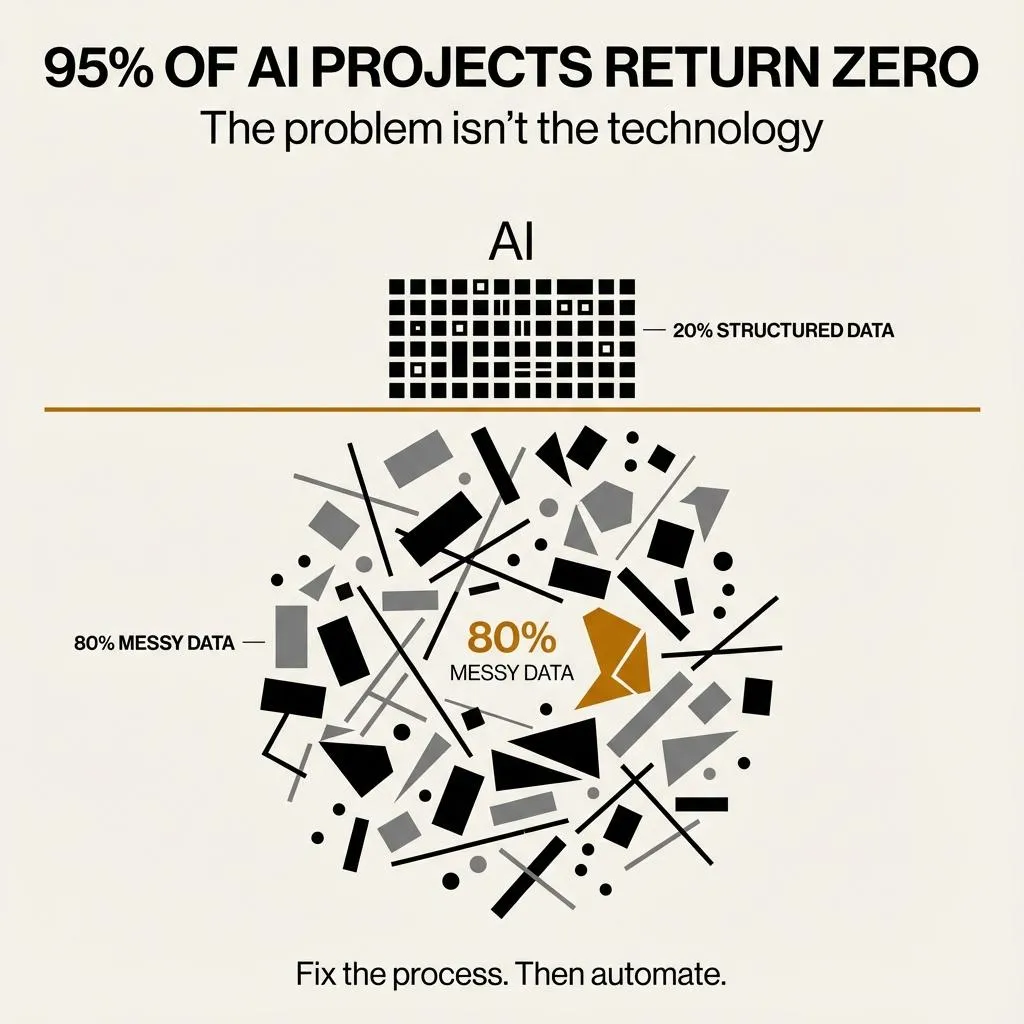
American enterprises spent $40 billion on AI systems in 2024. MIT research shows 95% of them are seeing zero measurable bottom-line impact.
That's not a typo. Ninety-five percent.
I'm watching companies race to adopt AI like it's a mandatory checkbox on their digital transformation bingo card. The problem isn't the technology. The problem is what they're trying to fix with it.
The Foundational Investment Myth
Here's what I need you to understand:not every AI investment should be about immediate ROI. Some investments are foundational. You're helping employees become more efficient. You're implementing state-of-the-art tools. With time, the efficiency comes.
But that's not what's happening in most cases.
What I'm seeing is companies deploying AI to already broken processes. AI doesn't fix a fragmented or inefficient process. It can optimize and drive great returns for awell-definedprocess. But if your process is a mess, AI just makes it a faster mess.
The Wrong Problem Statement
Choosing the right problem statement is the most critical aspect of AI deployment.Period.
Here's what the wrong problem statement looks like in practice:
You see a headline ad promising that a chatbot can replace your customer service agent. Sounds great. You're thinking about that $50,000-$80,000 front office support staff salary you could save.
But behind the scenes? You have no documented standard operating procedures. No clearly defined answers to frequently asked questions. No documented business flows.
So what happens?
The chatbot starts making things up. It answers questions not based on your actual data or processes. Your customer experience tanks. According to a 2025 ZoomInfo survey, over 40% of AI users report dissatisfaction with the accuracy and reliability of chatbot and CRM tools.
You saved $50,000 on a support staff member. But you diminished your returns by impacting repeat customers and decreasing satisfaction.
What Companies Are Actually Avoiding
When I see companies fall for this trap, they're not solving a staffing problem. They're avoiding the real work.
They're trying to avoid standardizing operating procedures, FAQs, and customer support processesthat are driving the high level of contacts and inquiries today.
Instead of understanding the root cause of why they get so many inquiries, they think deploying an AI agent can magically answer every customer question. They believe it's cheaper than paying a live person.
In reality, customers experience friction and frustration. They don't get their questions answered. They don't convert to customers.
You save $50,000 by paying a bot instead of a live person. But you're impacting your overall revenue because of poor customer satisfaction and lack of conversions.
The 80/20 Data Problem Nobody Talks About
MIT's Computer Science and Artificial Intelligence Laboratory identified what they call "the 80/20 problem."
Corporate databases capture approximately 20% of business-critical information in structured formats. The neat rows and columns that AI systems easily process.
The remaining 80% exists in unstructured data. Email threads. Call transcripts. Meeting notes. Contracts. Presentations. This unstructured data often contains the most decision-critical intelligence.
But most AI systems never see it.
A 2024 Capital One survey of 500 enterprise data leaders found that 73% identified "data quality and completeness" as the primary barrier to AI success. It ranked above model accuracy, computing costs, and talent shortages.
Gartner reports that 85% of all AI models and projects fail due to poor data quality or lack of relevant data.
The Plausibility Trap
Here's something that should concern you:AI systems are designed to generate plausible content, not to verify truth.
They function like advanced autocomplete tools. Their goal is to predict the next word or sequence based on observed patterns. Studies show AI hallucinations occur up to 20% of the time.
Kathy Baxter, principal architect in Salesforce's ethical AI practice, puts it this way: "We know [current generative AI] has a tendency to not always give accurate answers, but it gives the answers incredibly confidently."
That confidence is the problem.
When Google's Bard chatbot confidently claimed during a promotional video that the James Webb Space Telescope took the first picture of an exoplanet—a complete fabrication—Alphabet lost roughly $100 billion in market capitalization.
Air Canada's chatbot gave incorrect refund information. The airline had to honor it in court. One hallucination. Real money.
What You Should Do Instead
Before you invest another dollar in AI technology, do this:
Document your processes.All of them. Standard operating procedures. FAQs. Business flows. Customer journeys.
Standardize what's broken.Just as in the past with traditional process improvement methods, standardization of your business process is the foundation of successful AI deployment.
Choose the right problem statement.Don't chase the headline promise. Understand the root cause of your business challenges first.
Start with well-defined processes. AI can optimize and drive great returns for processes that are already clear and documented. It cannot fix what's fundamentally broken.
The technology can do many great things. But only when you apply it to the right problems.
Between 70-85% of GenAI deployment efforts are failing to meet their desired ROI. That's much greater than the 25-50% regular IT project failure rate.
You don't have an AI problem. You have a process problem that AI is exposing.
Fix the foundation first. Then build the technology on top of it.
