The Lifestyle Design Trap: Why 2026 Will Belong to the Intentionally Simple

TL;DR: More automation doesn't equal more freedom. I spent six months optimizing everything and ended up more burned out than when I started. Turns out, building systems between preschool pick up and client calls requires a different framework. The winners in 2026 won't be the most automated. They'll be the ones who protected their capacity to say no.
What this article covers:
Why AI tools are increasing burnout instead of reducing it
The hidden cost of productivity theater (context switching eats 22% of work time)
Decision sovereignty: protecting your ability to say no
Why the four-hour workweek model failed for most people
What intentional simplicity looks like in practice
What Is the Lifestyle Design Trap?
I spent six months automating everything. Between running a corporate AI program and building my own practice.
Email sequences. Content calendars. Client onboarding flows. I had AI tools running in the background of my background processes. I was optimizing during the 47-minute window between school pickup and dinner prep.
Then I woke up more exhausted than when I started.
The tools weren't the problem. I was using them to do more of the wrong things faster.
Why Is AI Increasing Burnout Instead of Reducing It?
Here's what I'm starting to see: AI isn't freeing us up. It's burying us.
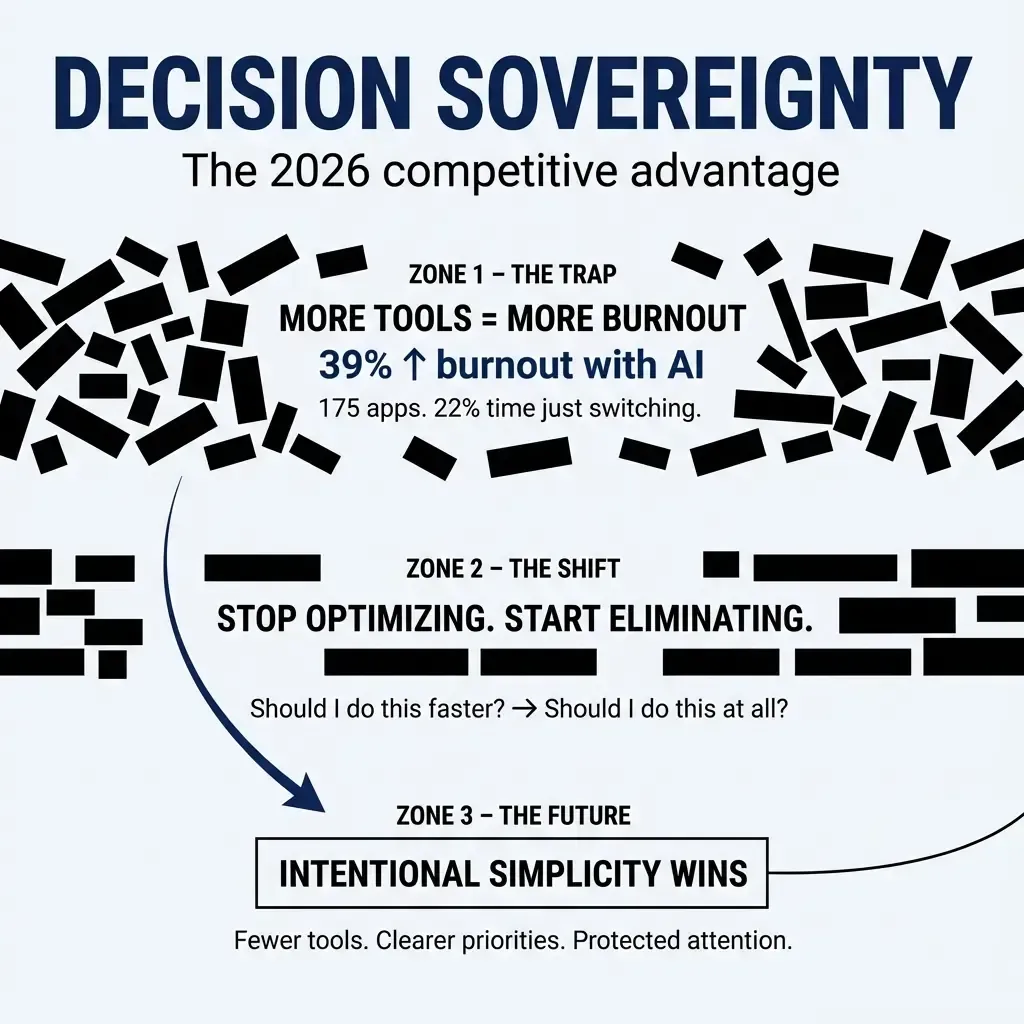
A 2024 study found radiologists using AI consistently were 39% more likely to experience burnout than those who didn't. Operational toil rose to 30% despite AI investment.
The more they automated, the more burned out they became.
Glassdoor data shows a 41% year-over-year surge in mentions of fatigue in company reviews. We're not getting freed up. We're getting buried under our own optimization.
Key insight: Automation without elimination amplifies the wrong work instead of removing it.
What Is the Real Cost of Productivity Theater?
I started noticing this pattern in my own work. Specifically at 2:47 AM on a Tuesday, nursing my baby in the dark.
I had my phone balanced against the nursing pillow, optimizing my Instagram content strategy. Scheduling posts. Analyzing engagement metrics. Running AI prompts to generate captions.
My daughter was feeding. I was productivity hacking.
That's when it hit me: I was using the only quiet hours I had to do work that didn't matter. The tools made it so easy to do more, I forgot to ask whether I should.
Employees now spend up to 22% of their time toggling between different applications. The average large organization deploys over 175 different apps.
We've built a productivity stack destroying our ability to produce.
The cognitive cost is staggering. Economists estimate information overload costs the global economy about $1 trillion in lowered productivity and reduced innovation.
Here's what got me: it takes around nine and a half minutes to return to focused work after switching between apps. Some research suggests it takes up to 23 minutes after one interruption… for me, it definitely leans towards the 23 minutes. Which matters when your entire work window is 90 minutes before someone needs a permission slip signed.
We're not working. We're context switching with occasional bursts of output. And when you're building a business in the margins of everything else, you don't have margins left for recovery.
Key insight: Your productivity stack is costing you more attention than it's saving you time.
How I Stopped Optimizing and Started Eliminating
My turning point came after weeks of those 2 AM optimization sessions.
I was exhausted. Not just sleep-deprived exhausted. Existentially exhausted. I realized I needed to refocus on my business in a niche where I could grow. Instead of trying to automate content creation across all platforms while bouncing a baby and managing a corporate transformation program, I took a step back.
A break to ask what I wanted to work on and where my passion lived. Not what my content calendar told me I should be doing at 3 AM.
That pause wasn't downtime. It was strategic clarification.
I stopped asking "how do I do this faster" and started asking "should I be doing this at all."
The shift was immediate. Not in output. In clarity.
Key insight: Strategic elimination beats tactical automation every time.
What Is Decision Sovereignty?
Here's the pattern I'm starting to see emerge: the winners in 2026 won't be the most automated.
They'll be the most intentionally simple.
They'll be the people who protected their capacity to say no.
I'm calling this decision sovereignty. The ability to make choices based on your priorities instead of what your productivity stack tells you is possible.
Because every tool you add creates a decision tax.
Should I post this here or there? Should I automate this sequence or another one? Should I integrate this platform with those three others? And can I get this done before the baby wakes up or before I need to be on a call or before school pickup?
The average knowledge worker checks email every six minutes. That's not a productivity problem. That's a decision fatigue crisis.
60% of people experience high stress and burnout because of online communication fatigue. Managers spend 2.6 hours daily searching for information across multiple systems.
We're drowning in capability and starving for clarity.
Key insight: Decision sovereignty means protecting your capacity to say no before adding another tool.
Why Did the Four-Hour Workweek Model Fail?
The traditional lifestyle design framework promised freedom through automation and outsourcing.
It didn't deliver.
Critics now note the passive income model has become a pipe dream. There are no automated cash cows running on four hours per week.
The fundamental flaw was assuming the right initial decisions would create an ideal lifestyle flowing easily from there.
Life doesn't work like this. Constraints shift. Priorities evolve.
What worked in 2010 for a single digital nomad doesn't work in 2026 for a mom building a business between school pickup and bedtime.
I'm running a corporate AI transformation program during the day. Building my own systems coaching practice at night and during nap times and in those fragmented 20-minute windows that appear randomly. Raising kids who need me present, not just physically there while I'm mentally toggling between Slack channels and wondering if I remembered to respond to that client email.
The four-hour workweek promised I could automate my way to freedom. What I needed was a framework designed for fragmented attention from the start. For work that happens in 12-minute increments. For strategy sessions conducted while rocking a crying baby. For decision-making that accounts for the fact that my brain is running three parallel operating systems simultaneously.
The model optimized for the wrong variables.
Key insight: Lifestyle design built on automation alone fails when your constraints shift. It especially fails when your constraints were never going to disappear.
What Does the Simplicity Countermovement Look Like?
I'm seeing this shift everywhere now.
People don't want more content. They want better connection.
The future of social media isn't louder. It's quieter, more intentional, and more human.
Organizations are consolidating, simplifying, and focusing on outcomes over features. The prediction is clear: the future isn't more tools. It's better tools.
There's data backing this up. Satisfied workers are approximately 2 times more productive. Over 80% of surveyed workers said enhancing their work experience would improve productivity.
Translation: people perform better when they're not buried under complexity.
Key insight: The shift toward intentional simplicity is already happening across industries.
How to Build Intentional Simplicity Into Your Work
This isn't about going off grid or rejecting technology.
It's about designing your systems to protect your capacity instead of consuming it.
Clutter becomes costly when digital tools fragment attention and create cognitive overhead. The principle is straightforward: configure your environment to maximize value rather than ease of access.
Intentionality trumps impulse.
Here's what I changed:
I stopped trying to be everywhere. I picked one platform where my people gather and went deep there. Because I don't have the bandwidth to manage five content calendars when I'm also managing snack schedules and project deadlines.
I eliminated tools requiring more management than they delivered value. If it took longer to maintain than it saved, I cut it. If I couldn't figure out how to use it effectively in a 15-minute window between meetings, it wasn't designed for my reality.
I built decision filters. Before adding anything new, I ask: does this reduce my decision load or increase it?
I stopped measuring productivity by output volume and started measuring it by alignment with what matters.
Key insight: Intentional simplicity starts with asking whether each tool reduces or increases your decision load.
What Will 2026 Look Like for Intentionally Simple Operators?
The dominant narrative says AI will make us superhuman.
I'm starting to see something different emerging.
The people thriving in 2026 will be the ones who used AI to eliminate noise, not amplify it. They'll be the ones who automated the trivial so they could focus on the meaningful.
They'll have fewer tools, clearer priorities, and protected attention.
They'll have built systems serving their lives instead of lives serving their systems. Systems that work when you have 20 minutes, not 2 hours. Systems that don't require you to optimize Instagram while your baby nurses.
Decision sovereignty will be the new competitive advantage. The ability to say no. The capacity to eliminate. The discipline to stay focused when everything around you is optimizing for distraction.
Lifestyle design isn't dead. It's evolving past the automation fantasy into something more honest: intentional simplicity in an age of infinite capability.
Key insight: The winners in 2026 will be the ones who automated less and eliminated more.
Frequently Asked Questions
What is decision sovereignty?
Decision sovereignty is the ability to make choices based on your priorities instead of what your productivity stack tells you is possible. It's about protecting your capacity to say no before adding another tool or commitment.
Why does automation increase burnout instead of reducing it?
Automation without elimination amplifies the wrong work. When you automate tasks without questioning whether they're worth doing, you end up doing more of the wrong things faster. Studies show radiologists using AI were 39% more likely to experience burnout because operational toil increased despite the technology.
What is the decision tax?
Decision tax is the cognitive load created by every tool, platform, or process you add to your workflow. Each one requires ongoing micro decisions: should I post here or there, automate this or another thing, integrate these platforms? These decisions drain mental energy even when they feel small.
How is intentional simplicity different from minimalism?
Intentional simplicity isn't about rejecting technology or going off grid. It's about designing systems to protect your capacity instead of consuming it. You configure your environment to maximize value rather than ease of access, keeping only tools reducing your decision load.
Why did the four-hour workweek model fail?
The model assumed the right initial decisions would create an ideal lifestyle flowing easily forever. Life doesn't work like this. Constraints shift and priorities evolve. What worked for a single digital nomad in 2010 doesn't work for someone with parallel obligations and fragmented attention in 2026.
How do I know if a tool is worth keeping?
Ask: does this tool reduce my decision load or increase it? If it takes longer to maintain than it saves, cut it. Measure whether it protects your capacity or consumes it. The goal isn't more capability. It's clearer priorities.
What does productivity look like with intentional simplicity?
Stop measuring productivity by output volume. Start measuring it by alignment with what matters. Focus on one platform where your people gather instead of trying to be everywhere. Automate the trivial so you have capacity for the meaningful.
How do I start building decision sovereignty?
Take inventory of your productivity stack. Count how many tools you're maintaining and how many decisions you're making to keep the system running. Then cut half. Build decision filters before adding anything new. Protect your capacity to say no.
What's Your Decision Tax?
Take inventory of your productivity stack right now.
How many tools are you maintaining? How many decisions are you making to keep the system running? How many of those decisions are happening during time you'll never get back?
What would happen if you cut half of them?
Not someday. This week.
What's the one thing you're automating where you should be eliminating?
Key Takeaways
Automation without elimination amplifies the wrong work. AI is increasing burnout because we're doing more of the wrong things faster.
Context switching costs 22% of work time. The average worker toggles between 175+ apps, taking 9 to 23 minutes to refocus after each interruption.
Decision sovereignty is the new competitive advantage. Every tool creates a decision tax. Winners in 2026 will protect their capacity to say no.
The four-hour workweek model failed because life doesn't work in straight lines. Constraints shift and what worked in 2010 doesn't work in 2026.
Intentional simplicity beats optimization. Design systems protecting your capacity instead of consuming it. Measure productivity by alignment, not output volume.
Strategic elimination beats tactical automation. Before adding a tool, ask: does this reduce my decision load or increase it?
The future belongs to the intentionally simple. People thriving in 2026 will have fewer tools, clearer priorities, and protected attention.
